Guide
AI receptionist vs. ISA vs. answering service: which one should answer your calls?
TL;DR
- An answering service takes messages. An ISA sells. An AI receptionist answers in your name, books on your calendar and sends you the transcript.
- A great ISA is the strongest human option if you have the call volume and the budget to hire, train and manage one.
- An answering service is fine for messages but rarely knows your calendar or your business.
- Most solo agents and small teams are best served by an AI receptionist for the calls they miss, with a person for follow-up. Many teams end up using both.
Agents ask me which option is best as if there's one right answer. There isn't. There's a right answer for your volume, your budget and how you like to work. Here's how the three actually compare, including when I'd tell you not to use what I sell.
Every few weeks an agent asks me which is better: an ISA, an answering service, or an AI receptionist. Usually they've already been pitched by someone selling one of the three.
I sell one of the three. So I'll give you the comparison I'd want, including the cases where I'd tell you to hire a person instead. This is part of the bigger guide on why missed calls cost agents deals.
What's the difference between an AI receptionist, an ISA and an answering service?
They solve different problems. An answering service has a person take a message when you can't pick up. An inside sales agent (ISA) is a salesperson who works your leads by phone and sets appointments. An AI receptionist answers your missed calls as your assistant, books them on your real calendar and sends you a recap.
Put another way:
- Answering service: "Let me take a message for Dana."
- ISA: "Let me find out if you're ready to buy, and get you in front of Dana."
- AI receptionist: "This is Dana's AI assistant. Does Tuesday at 4:30 work to talk with Dana?"
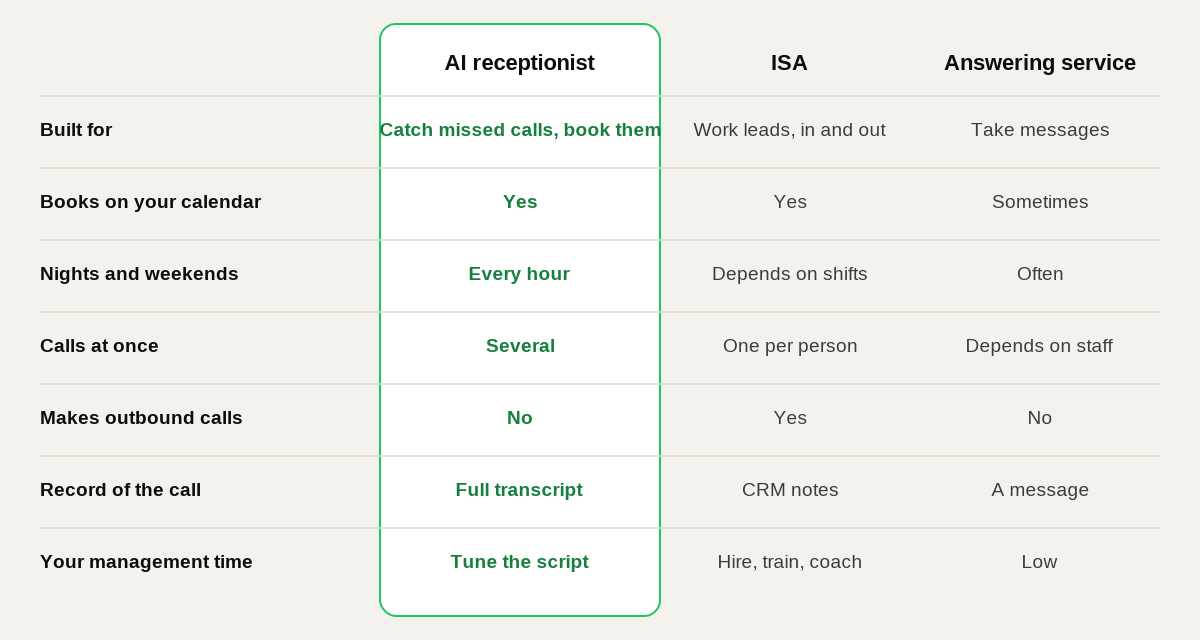
Here's the full comparison:
| AI receptionist | ISA | Answering service | |
|---|---|---|---|
| What it's built for | Catching inbound calls you miss and booking them | Working leads, inbound and outbound | Taking messages |
| Books on your real calendar | Yes | Yes | Sometimes, often not |
| Nights, weekends, holidays | Every hour, every day | Depends on shifts | Often, depends on plan |
| Calls at the same time | Several side by side | One per person | Depends on staffing |
| Makes outbound calls | No, it answers | Yes, that's the core of the job | No |
| Knows your business | What you set up and tune | Learns over time | Usually a short script |
| Record of the call | Full transcript and summary | Notes in your CRM, if they're disciplined | A message |
| Says it's an AI | Yes, every call | N/A | N/A |
| Your management time | Tune the script now and then | Hiring, training, coaching, payroll | Low |
When is an ISA the right call?
When you have more leads than you can work yourself and the budget to pay, train and manage a salesperson. A great ISA is the strongest human option on this list. They don't just answer. They call back old leads, work your database, follow up for months and build real rapport.
Signs you're ready for an ISA:
- Leads are going stale because nobody calls them back for a week.
- You're paying for leads you don't have time to call.
- You have a team, and agents are waiting on appointments.
- You're willing to manage a person: scripts, call reviews, accountability.
The trade-offs are real. A good ISA is hard to find and expensive to keep. They work shifts, take vacations and quit. And one ISA still takes one call at a time.
An AI receptionist doesn't replace any of that outbound work. If you need someone dialing your old leads every morning, you need a person.
When is an answering service enough?
When all you need is a message and you're happy to make the call yourself. An answering service puts a real person on the line, which some callers prefer, and they're good at taking down a name, a number and a reason.
Where answering services tend to fall short for agents is everything after the message. Most don't know your calendar, so they can't book. Most work from a short script, so they can't tell a seller who wants to list this spring from a buyer asking about a sign. And the caller still waits for your call back, which is exactly where phone tag starts.
If your business runs on referrals and past clients who will happily wait a day for you, a message might be all you need.
When does an AI receptionist make the most sense?
When you miss calls because you're busy with clients, you want those calls answered and booked right away, and you're not ready to hire a salesperson. That describes most solo agents and small teams I know.
What you get:
- She answers in your name and says she's your AI assistant.
- She asks your questions: who they are, what they need, and when.
- She books a real time on your Google or Microsoft calendar.
- She sends you the recap with the full transcript, before you're back in the car.
- She takes several calls at once, so an open house or a new listing doesn't send anyone to a busy signal.
- She works after hours without a shift schedule, including the 9 PM call.
- She remembers repeat callers by their number, so nobody starts over.
What she won't do: give home values, rates, loan approvals or commission information, give legal or financial advice, or say anything that crosses fair housing lines. She also won't make outbound calls or chase your old leads. That's an ISA's job.
An answering service takes the message. An ISA works the lead. An AI receptionist makes sure the conversation happens while the caller is still on the phone.
How do callers feel about talking to an AI?
Better than they feel about voicemail, in my experience, as long as two things are true: she tells them she's an AI right away, and she actually helps. What annoys callers is being tricked, put on hold, or left waiting until tomorrow. A receptionist that says "I'm Dana's AI assistant, I can get you on her calendar" and does it, in under two minutes, solves the caller's problem.
The disclosure part isn't optional for us. Ours says she's an AI on every call and never pretends to be a person. If you're curious about the legal side in California, I cover recording consent and disclosure in California call recording and your AI receptionist.
The best way to judge this is to hear it. Call Clarice, the demo receptionist on our home page, and play a seller. You'll know in a minute whether your callers would be comfortable.
Can you use more than one?
Yes, and for teams it's often the best setup. The receptionist catches every inbound call, books what she can and sends the recap. The ISA, or you, works the leads that need a human touch and makes the outbound calls.
A few combinations I see work well:
| Your situation | A setup that fits |
|---|---|
| Solo agent, misses calls at showings | AI receptionist on missed calls; you call back from the recap |
| Busy solo agent with paid leads | AI receptionist on missed calls; a part-time ISA for outbound follow-up |
| Small team | AI receptionist as the front door; the team lead routes recaps; see AI answering for teams |
| Referral-based agent with few new callers | Voicemail you check, or an answering service, may be enough |
How do you decide?
Start with your own calls, not with a sales pitch. Count last week's missed, declined and busy calls. Look at when they came in. Then ask yourself two questions.
First, do the missed calls need a message, a booking or a salesperson? A message means an answering service. A booking means a receptionist. A salesperson means an ISA.
Second, what can you manage? A person needs hiring, training and supervision. A receptionist needs a careful setup and an occasional script tune. Voicemail needs you to call back fast, every time.
If the answer is a receptionist, setup takes one code from your phone. The carrier-by-carrier steps are in how to forward missed calls to an AI receptionist.
Questions agents ask
What does an ISA do in real estate?
An inside sales agent is a salesperson whose job is phone and text conversations: calling new leads, qualifying them and setting appointments for the agents who go out on them. A good ISA works your database every day, not just the calls that come in.
Is an AI receptionist the same as an answering service?
No. An answering service has a person take a message and pass it along. An AI receptionist answers as your assistant, asks your questions, books a real time on your calendar and sends you a recap and full transcript. It also says it's an AI.
Can an AI receptionist replace an ISA?
Not entirely. An AI receptionist is built to catch inbound calls you miss and book them. An ISA also makes outbound calls, works old leads and builds relationships over weeks. If you need that outbound work, you need a person.
Which option is best for a solo agent?
For most solo agents, an AI receptionist for missed calls plus the agent's own follow-up. Hiring an ISA usually only pays off once you have more leads than you can work yourself.
Will callers be annoyed by an AI?
Callers are annoyed by voicemail, hold music and phone tag. A receptionist that says up front it's an AI, gets them what they called for and books a time usually lands better than a message nobody returns until tomorrow.
Can I use an AI receptionist and an ISA together?
Yes, and many teams should. The receptionist catches every inbound call and books what it can. The ISA works the leads that need human follow-up and the outbound calls an AI receptionist doesn't make.
Hear what your callers would hear.
Clarice is the demo receptionist on our home page. Call her, pretend you're a seller, and try to stump her. Then book fifteen minutes with Connor if you want one of your own.