Guide
California call recording rules and your AI receptionist, in plain English
TL;DR
- California generally requires the consent of everyone on a confidential call before it's recorded (Penal Code 632, and 632.7 for cell phones).
- Penal Code 637.2 lets a person sue for $5,000 per violation or three times actual damages, whichever is more.
- The AI laws people cite mostly cover online bots (SB 1001) and outbound robocalls (the FCC's 2024 ruling, AB 2905). We found no California law requiring disclosure on inbound calls.
- Do it anyway: the first sentence should say she's an AI and the call is recorded. This is not legal advice; check with your broker or a California real estate attorney.
Any receptionist that transcribes your calls is recording them, and California takes recording seriously. Here's what the main laws say, in plain words, what they don't cover, and how we set up the opening of every call so agents don't have to worry about it.
I'm a Realtor, and I spent twenty years with the LAPD. I'm not your lawyer. What follows is how I read the main California rules on recording and AI, written so an agent can follow it, plus the way we set up every receptionist so the question mostly answers itself. For your own situation, check with your broker or a California real estate attorney.
This is part of the guide on why missed calls cost agents deals.
Is it legal to record a phone call in California?
Yes, if everyone on a confidential call consents. California Penal Code 632 makes it illegal to intentionally record a confidential communication without the consent of all parties. Penal Code 632.7 applies the same idea to calls involving cell phones and cordless phones, which covers almost every call an agent gets today.
"Confidential" has a specific meaning in the statute: a conversation where the circumstances reasonably show someone wants it kept between the people on the call. A seller describing their divorce timeline or their finances on a call to an agent's office fits that description easily. Don't count on a call being "not confidential."
The practical rule is simple. If the call is recorded, tell the caller at the start. When the caller hears that and keeps talking, they're consenting with full knowledge.
What happens if you get it wrong?
It gets expensive fast. Penal Code 637.2 lets a person who was recorded without consent sue for the greater of $5,000 per violation or three times their actual damages, and they don't have to prove they were actually harmed. There are criminal penalties, too, including fines and possible jail time.
Now picture a receptionist answering a few hundred calls a year without a disclosure. That's not a risk I'd take with my license, and it's not one I'd let an agent take on a system I built.
One sentence at the top of the call costs you three seconds. Skipping it can cost you $5,000 a call.
Is an AI receptionist "recording" the call?
Treat it as yes. A receptionist that gives you a full transcript of the conversation has to capture the conversation to produce it. Whether the audio file is kept, deleted or never stored, the safe assumption is that you're recording, and you disclose.
This is also why I like the transcript so much. Once you're disclosing anyway, you get the benefit: every word of every call, in writing, readable in ten seconds between appointments. You stop relying on "I think she said she wanted to list in the spring."
Does California require an AI to say it's an AI?
On inbound phone calls, we couldn't find a California statute that requires it. The laws people usually point to cover different situations:
| Law | What it covers | Does it reach an AI answering your inbound calls? |
|---|---|---|
| SB 1001 (Business and Professions Code 17940 to 17943, 2019) | Using a bot online to mislead people about being a bot, to sell something or sway a vote | Its text says online; it doesn't clearly reach phone calls |
| FCC Declaratory Ruling 24-17 (February 2024) | AI-generated voices count as "artificial" voices under the TCPA | The TCPA's voice rules are about calls placed to consumers, like robocalls |
| AB 2905 (2024, effective January 1, 2025) | Automatic dialing devices must tell the person if the recorded message uses an artificial voice | Outbound automated calls, not answering |
| Penal Code 632 and 632.7 | Recording a confidential call | Yes, whenever the call is recorded |
So the law that clearly reaches your receptionist is the recording law. The AI disclosure laws are mostly aimed at outbound robocalls and online bots. Laws in this area are changing fast, and I'd expect more of them, which is one more reason to disclose now instead of retrofitting later.
Why disclose that she's an AI if the law doesn't require it?
Because it's the right thing to do, and because it works. A caller who figures out halfway through that they've been talking to a machine feels tricked. Tricked callers don't book appointments, and they definitely don't list with you.
Our receptionists say they're AI on every call and never pretend to be a person. I go deeper on the trust side in should your AI receptionist tell callers it's an AI.
There's one more reason. You're a licensee, and the person answering your phone, human or not, speaks for you. I'd rather your receptionist hold herself to a stricter standard than the law asks.
What should the first sentence of every call be?
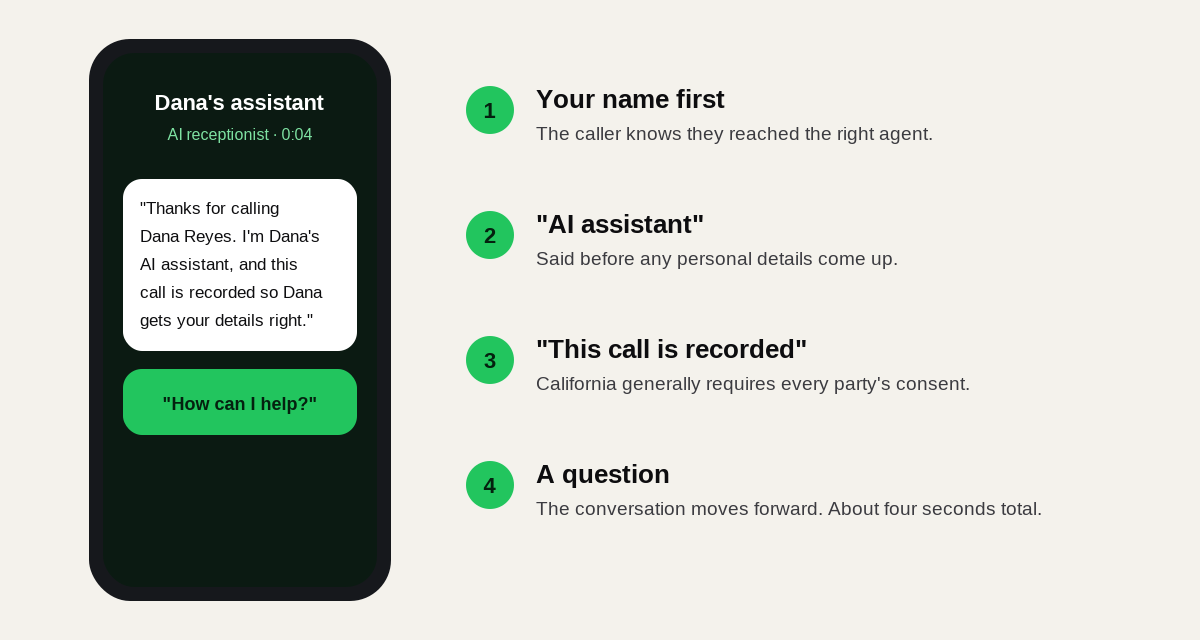
One sentence that covers both disclosures, sounds human and gets to the point. Here's the shape we recommend:
Why it works:
- It starts with your name, so the caller knows they reached the right agent.
- It says AI in the first breath, before any personal details come up.
- It says recorded, with a reason that makes sense to the caller.
- It ends with a question, so the conversation moves forward.
The whole thing takes about four seconds. Callers barely notice it, which is the point.
What else should an agent watch for?
A few things outside the recording question are worth a minute of thought:
- What she says about property. No home values, price opinions, rates or loan approvals. Those belong to you, the licensee, or to a lender.
- Fair housing. No comments on schools, neighborhoods or who lives where. I cover how to write these rules in what an AI receptionist should never say.
- Your brokerage's policies. Some brokerages have rules about call recording, transcription vendors or where client data lives. Ask before you turn anything on.
- Where the data lives. With Agent Voice Pro, your callers and transcripts live in your own account, under your name, never sold or shared.
- Outbound is a different world. Everything here is about answering calls. If you ever want AI to place calls or send texts, consent and registration rules come into play. That's a separate conversation with your attorney.
What's the simplest safe setup?
Keep your number and your phone. Let only missed, declined and busy calls roll over using conditional call forwarding. Have the receptionist open every call with the AI and recording disclosure. Give her a clear never list. Keep the transcripts in your own account.
That covers the recording rule, gets ahead of the disclosure question, and protects your license. Then run it past your broker, and if you have specific concerns, a California real estate attorney. I'd rather you ask one extra question than skip one.
Questions agents ask
Is California a two-party consent state for recording calls?
Yes, in practice it's an all-party consent state. Penal Code 632 makes it illegal to record a confidential communication without the consent of everyone involved, and Penal Code 632.7 covers calls involving cell and cordless phones.
Does an AI receptionist count as recording the call?
If it produces a transcript or saves the audio, treat it as recording. The safe practice is to tell the caller at the start that the call is recorded, so continuing the call is informed consent.
Does California law require an AI to say it's an AI on a phone call?
We couldn't find a California statute that requires it on inbound calls. SB 1001 covers bots online, and AB 2905 covers automated outbound calls. We disclose on every call anyway, because callers deserve to know.
What happens if you record a call without consent in California?
Penal Code 637.2 allows a civil lawsuit for the greater of $5,000 per violation or three times actual damages, and the person doesn't have to prove actual damages. There are criminal penalties, too.
Does the FCC's AI voice ruling apply to an AI receptionist?
The FCC's February 2024 ruling says AI-generated voices count as artificial voices under the Telephone Consumer Protection Act. That law is about calls placed to consumers, like robocalls. An AI receptionist answering calls people place to you is a different situation. Ask your attorney about yours.
What should my AI receptionist say at the start of a call?
Something like: "Thanks for calling Dana Reyes. I'm Dana's AI assistant, and this call is recorded so Dana gets your details right. How can I help?" It's short, friendly, and covers both disclosures.
Hear what your callers would hear.
Clarice is the demo receptionist on our home page. Call her, pretend you're a seller, and try to stump her. Then book fifteen minutes with Connor if you want one of your own.