The complete guide
Missed calls are costing you deals. Here's the math, and the fix
TL;DR
- You miss more calls than you think. Showings, closings, open houses, driving and sleep all send callers to voicemail.
- Run the math on your own numbers: missed calls a week, times 52, times the share that were real business. It only takes one to be a listing.
- Callers who hit voicemail often dial the next agent. The first real conversation usually sets the appointment.
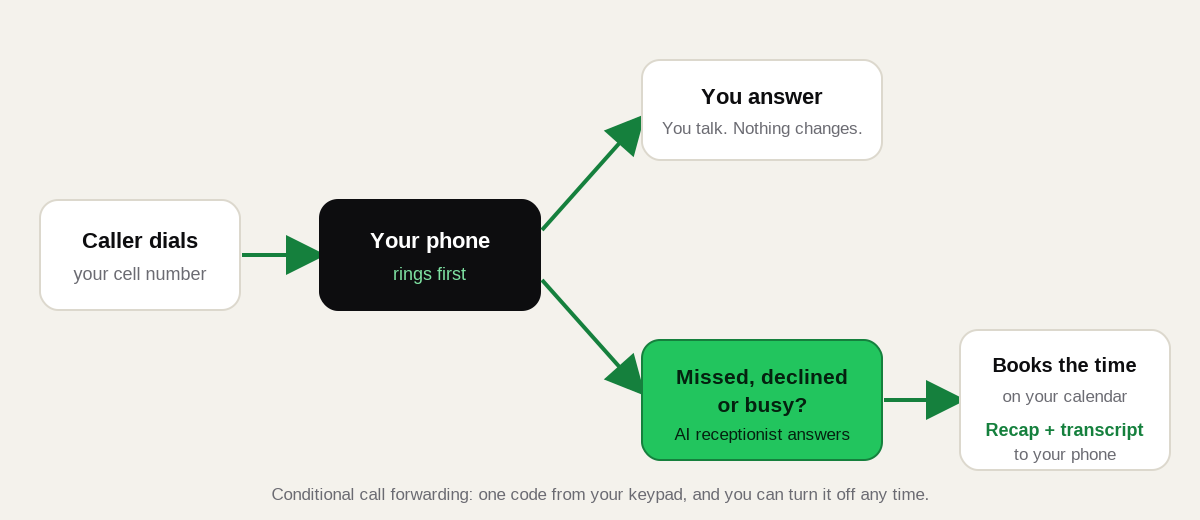
- The fix keeps your number and your phone. Your phone rings first, and only the calls you miss roll over to a receptionist who books the time and sends you the recap.
This is the guide I wish someone had handed me in 1998. It walks through where your missed calls come from, how to put a number on what they cost you, every option for getting them answered, and how to set up the one I built for myself after years of calling people back from the car.

I spent twenty years with the LAPD and most of the last three decades carrying a phone for my real estate clients. Both jobs taught me the same thing. The call you don't answer is the one that matters.
You know the moment. You're walking a buyer through a kitchen. Your phone buzzes in your pocket. Unknown number, local area code. You can't step out. By the time you're back in the car, it's a missed call with no voicemail, and when you call back, nobody picks up.
Was it a seller? A buyer off your sign? A wrong number? You'll never know. That's the problem this whole guide is about.
How many calls do real estate agents actually miss?
More than you think, and the only number that counts is yours. Agents miss calls during showings, listing appointments, closings, open houses, drives, family dinners and sleep. That's not a discipline problem. It's the job. You can't be with a client and on the phone at the same time.
Here's a five-minute exercise. Open your phone's recent calls and scroll back seven days. Count three things:
- Calls marked missed.
- Calls you declined because you were with someone.
- Calls that went to voicemail while you were already on another call.
Now look at the times. If you're like most working agents, they cluster. Saturday and Sunday afternoons when you're hosting or showing. Weekday evenings when the rest of the world is off work and finally has time to think about moving. Early mornings before your first appointment.
That cluster tells you something important. People call agents when they have time, and the times they have free are the times you're busy serving somebody else.
What does one missed call cost an agent?
It depends on who was calling, which is exactly why it's expensive. Most missed calls are nothing: a robocall, a vendor, your dentist. A few are business. And once in a while, one of them is a seller ready to list or a buyer ready to write. You don't get to pick which call you miss.
So don't guess. Run your own math. On our home page there's a little slider that does this, and here's what it's doing under the hood:
| Step | What you plug in | Example |
|---|---|---|
| 1 | Calls you miss in a typical week | 4 |
| 2 | Times 52 weeks | 208 missed calls a year |
| 3 | The share that were real business (your guess, from your recent calls) | You decide |
| 4 | The share of those you'd normally turn into an appointment | You decide |
| 5 | Your average check on a closed deal | You know it |
Four missed calls a week is 208 callers a year who got your voicemail. I'm not going to tell you what share of those were sellers, because I don't know your market or your marketing. But I'll tell you what I know from my own phone: it only takes one to be a listing.
It only takes one missed call to be a listing. You don't get to choose which one.
Here's the other side of the ledger. Whatever you do about missed calls has a cost, too. Your time calling back. An assistant's salary. A service's monthly fee. When you compare options later in this guide, compare them against that one listing, not against zero.
Which missed calls matter most?
The ones from people who are deciding right now. Not every caller is equal, and it helps to know which calls to protect first. When I look at the calls agents miss, they fall into a few groups:
| Caller | Why they're calling | What happens if they hit voicemail |
|---|---|---|
| Sign caller | Standing in front of a listing, curious right now | They search the address and call the next agent they find |
| Portal caller | Saw a home online and wants to see it this week | They tap the next agent on the listing page |
| Open house visitor | Toured the house, has a follow-up question | They ask whoever answers first |
| Seller with a value alert | Just got a number in their inbox and wants to talk | They call the agent whose name is on the next postcard |
| Past client or referral | Knows you, trusts you | Usually waits, but notices how long you take |
| Vendors and robocalls | Selling you something | Nothing. Let them go |
Look at the top four rows. Those callers are mid-decision, and they have other numbers in front of them. That's where a missed call costs the most. The bottom rows are the calls you can safely return later. A good setup treats them differently, and I walk through the first group in sign calls and portal calls and open house follow-up.
Why don't callers leave a voicemail anymore?
Because they don't have to. A caller with a real estate question usually has more than one agent's number in front of them. A buyer standing in front of a yard sign can see the brokerage, search the address, and find three other agents on the portals before your voicemail greeting finishes. A seller who just got a home value alert can tap the next name on the list.
Think about how you behave as a customer. You call a plumber at 7 PM. It goes to voicemail. Do you leave a detailed message and wait for a call back tomorrow? Or do you call the next plumber? Your callers are no different.
The callers who do leave messages tend to leave the least useful one in the world: "Hey, call me back." No name. No address. No idea whether they're buying, selling, or asking about the open house. You call back from the car, they don't answer, and now you're both playing phone tag.
Voicemail was built for a time when people waited. Your callers don't.
Why does the first real conversation win?
Because the first agent who has an actual conversation with a caller gets to set the next step. Not the first one who calls back. The first one who talks to them, learns what they need, and puts a time on the calendar.
When a seller calls three agents and one of them gets a real conversation going ("Tell me about the house. When are you thinking of moving? Does Tuesday at 4:30 work to walk through it?"), that seller now has an appointment. The other two agents are calling back into a conversation that already happened. They're competing for a slot that's already filled.
Police work runs on a version of the same rule: whoever gets there first and starts the conversation shapes what happens next. Real estate isn't policing, but the principle carries. Being first with something useful beats being better later.
This is why the details of how fast you respond matter less than one simple question: when someone calls, does a conversation happen?
What are your options for answering calls you can't take?
You have six realistic options, and every one of them has a real trade-off. Here they are side by side:
| Option | Who answers | Books appointments? | Works at 9 PM? | Main trade-off |
|---|---|---|---|---|
| Answer everything yourself | You | Yes | If you're awake | You're never fully present with the client in front of you |
| Voicemail | Nobody | No | Yes | Many callers hang up; the ones who stay leave "call me back" |
| A spouse, partner or team member | A person you trust | Sometimes | Sometimes | It's their time, and it doesn't scale |
| Answering service | A trained operator | Sometimes | Often | Takes messages well; rarely knows your calendar or your business |
| Inside sales agent (ISA) | A dedicated salesperson | Yes | Depends on shifts | The strongest human option, and the most expensive one to hire and manage |
| AI receptionist | An AI that says it's an AI | Yes, on your real calendar | Yes, every night | Needs a careful setup: what she says, what she never says |
I go through each of these in detail in AI receptionist vs. ISA vs. answering service, including when a human is the better call. Short version: if you have the volume and the budget for a great ISA, hire one. Most solo agents and small teams don't, and that's the gap an AI receptionist fills.
How does an AI receptionist answer calls without taking over your phone?
With a feature your carrier already gives you, called conditional call forwarding. You keep your number. You keep your phone. Your phone rings first, every time. Only when you don't pick up, decline the call, or you're already on another line does the call roll over to your receptionist.
Setup is one short code dialed from your own phone. On Verizon, for example, it's *71 followed by the number you're forwarding to, and *73 turns it off. AT&T and T-Mobile use different codes, and Android phones also have a menu for it. I walk through every carrier, how to test it and how to turn it off when you want your old voicemail back in how to forward missed calls to an AI receptionist.
What this means in practice:
- Your sign, your card and your website don't change.
- The calls you answer, you answer. Nothing sits in between you and your clients.
- The receptionist only gets the calls that would have gone to voicemail.
- You can turn it off from your own phone in a few seconds.
That last point matters to me. I wouldn't put anything between me and my clients that I couldn't shut off myself, from the keypad, in the parking lot.
What should the receptionist actually do on a missed call?
Four jobs, in this order: answer in your name, find out who's calling and what they need, put a time on your calendar, and tell you about it. Anything beyond that is a bonus. Anything that skips one of those four is just a fancier voicemail.
Here's what a good missed call sounds like. A seller calls while you're mid-showing:
- Answer in your name. "Thanks for calling Dana Reyes. This is Dana's AI assistant. How can I help?"
- Get the who and the what. Name, callback number, what they need, and when. "We're thinking about selling our place this spring."
- Book it. "Dana would love to walk you through it. Does Tuesday at 4:30 work?" That's a real open slot on your real Google or Microsoft calendar, not a promise to call back.
- Tell you. Before you're back in the car, your phone shows the caller's name, number, what they want and the booked time. The full transcript and a summary are in your app.
Two smaller features make a bigger difference than you'd expect.
First, remembering repeat callers. When someone calls back, she recognizes the number and picks up where they left off: "Hi Maria, are you calling back about selling your home?" Nobody has to start over.
Second, taking several calls at once. Your cell takes one call. When the listing hits the portals or the open house sign goes up, five people might call in the same ten minutes. A receptionist can talk to all of them side by side. Nobody hears a busy signal.
And for the caller who says, "Just take a message"? She takes the message and lets them go. Not every caller wants a conversation, and a good receptionist can tell the difference.
What should an AI receptionist never say to your callers?
This is the part most people skip, and it's the part that protects your license. A receptionist answering in your name has to stay in her lane. Ours is built around a hard "never" list:
- Never pretend to be a person.
- Never give home values, price opinions, rates, loan approvals or commission information.
- Never give legal, tax or financial advice.
- Never say anything that crosses fair housing lines. That means no comments on schools, neighborhoods or who lives where.
- Never make promises you didn't authorize.
When a caller asks "What's my house worth?" the right answer is a booked appointment with you, not a number. That's not a limitation. That's the receptionist doing her job: getting the caller to the licensed professional who can actually answer.
You decide the rest. Your service areas, your hours, how you want buyer calls handled versus seller calls, which appointment types she can book. If you'd say it differently, it gets changed. I'll go deeper on writing these rules in what an AI receptionist should never say.
Is it legal in California to have an AI answer and record calls?
It can be, if you set it up the right way. California generally requires the consent of everyone on a confidential call before it's recorded (Penal Code 632, and 632.7 for cell phones). So the receptionist should say at the start that she's an AI and that the call is recorded. That's the opening we recommend.
The disclosure question is simpler than people think. I couldn't find a California statute that requires an AI to identify itself when it answers an inbound call. The rules people point to cover online bots and outbound robocalls. We disclose anyway, because a caller who finds out later they were talking to a machine feels tricked, and tricked callers don't list with you.
I lay out what each law covers, in plain words, in California call recording and your AI receptionist. I'm a Realtor, not your attorney. For your situation, check with your broker or a California real estate attorney.
How do you follow up on the calls the receptionist caught?
Fast and specific. The recap tells you who called and why, so your callback can start where the conversation left off instead of from zero. "Hi Mark, this is Dana. I saw you talked to my assistant about selling in the spring, and we're set for Tuesday at 4:30. Anything you want me to look at before then?"
That call takes ninety seconds and it lands completely differently from "Hi, this is Dana returning your call, what can I do for you?" The caller feels heard. You sound prepared. And you're confirming an appointment, not chasing one.
A few habits that work:
- Read the transcript before you dial. It takes ten seconds and it keeps you from asking questions they already answered.
- Call back the same day for anything booked or flagged urgent. The appointment is set, but a personal touch locks it in.
- Let the receptionist handle reschedules. "Need to move it? Call my assistant, she has my calendar." No phone tag.
I put together exact callback scripts in what to say when you call back a missed lead.
Can you hand out your assistant on purpose?
Yes, and it's the move almost nobody thinks of. The receptionist isn't only for calls you miss. If she knows your calendar, you can tell people to call her.
A buyer wants to see homes this weekend while you're on the way to a listing appointment: "Don't wait on me. Call my assistant. She has my calendar." A seller at your open house wants to talk next week: "Give my assistant a call. She'll get you on my schedule." Someone needs to move an appointment: "Call my assistant. She'll find you a new time."
You stay in the conversation that matters right now. The booking happens without you. More on this in hand out your assistant on purpose.
Who built this, and why?
I did, because I needed it. I've been a California Realtor since 1998, CalDRE #01238257. For twelve of those years I was also with the LAPD, from 1990 to 2010, so I learned early what it means to miss calls while you're doing your other job.
I've taught AI to brokers and agents at the Southland Regional Association of Realtors, twice for brokers and twice for agents, and in offices like Realty One Group and Sync. After every talk, the same question came up: "Can you just set this up for me?" Agent Voice Pro is that answer.
I build much bigger AI systems for businesses. This one is the basic every agent needs. If you take care of clients, you need someone answering when you can't. The longer version of how a cop ended up building AI for agents is in from LAPD to Realtor to AI.
How do you get started this week?
You can fix most of this in one sitting. Here's the order I'd do it in:
- Count. Do the recent-calls exercise from the top of this guide. Write down missed, declined and busy calls for the last seven days.
- Decide what callers should hear. Your name, your areas, your hours, and the one thing you most want to know from every caller.
- Write your never list. Start with values, rates, commission, legal advice and fair housing topics. Add anything specific to your business.
- Pick your option. Voicemail you actually check, a person, a service, or an AI receptionist. Use the comparison table above.
- Set up conditional forwarding to whatever you picked. Keep the off code in your notes.
- Test it. Call your cell from another phone and let it ring. Then call again and decline it. Then call while you're on another call. Every path should end with a real answer.
- Read the recaps for a week. Fix whatever sounds off. A receptionist gets sharper every week if someone's tuning the script.
If you want to hear what your callers would hear before you decide anything, call Clarice. She's the demo receptionist on our home page. Pretend you're a seller and try to stump her. Your own receptionist gets the name and the voice you pick.
Missed calls aren't a character flaw. They're the cost of being with your clients. You just don't have to keep paying it.
Every guide in this series
- AI receptionist vs. ISA vs. answering service: which one should answer your calls?A side-by-side look at the three ways real estate agents get missed calls answered, what each one does well, where each falls short, and how to choose.
- California call recording rules and your AI receptionist, in plain EnglishCalifornia generally requires everyone's consent to record a call. What that means for an AI receptionist, which AI laws apply, and the opening line we recommend.
- From LAPD to Realtor to AI: why I built Agent Voice ProConnor MacIvor served with the LAPD from 1990 to 2010 and has been a California Realtor since 1998. How that path led to an AI receptionist built for agents.
- How to forward only your missed calls to an AI receptionist (Verizon, AT&T, T-Mobile)Conditional forwarding sends only the calls you miss, decline or can't take to your receptionist. The codes for Verizon, AT&T and T-Mobile, and how to test them.
Questions agents ask
How many calls does a real estate agent miss in a week?
Nobody can answer that for you, and any number you read online is a guess. Open your phone's recent calls, count the missed and declined calls from last week, and add the ones that went to voicemail while you were on another call. That count is the only one that matters.
Do people still leave voicemails for real estate agents?
Some do. Many don't. A buyer looking at a sign or a seller who just saw a home value alert usually has a list of agents, and when one goes to voicemail, the next number is one tap away. Plan for the caller who hangs up, not the one who leaves a message.
Will an AI receptionist replace my phone number?
No. You keep the number on your sign, your card and your website. Your phone rings first. Only the calls you miss, decline or can't take while you're busy roll over, using conditional call forwarding from your carrier.
Will callers know they're talking to an AI?
They should, and with Agent Voice Pro they do. She introduces herself as your AI assistant at the start of every call. Pretending to be a person is the fastest way to lose a caller's trust.
What does an AI receptionist do with a missed call?
She answers in your name, gets the caller's name, number and what they need, books a time on your real calendar, flags anything urgent and sends you a recap with the full transcript. You call back knowing exactly who you're calling and why.
Is it legal to have an AI answer and record calls in California?
California requires every party's consent to record a confidential call, so the receptionist should say at the start that she's an AI and that the call is recorded. That's the opening we recommend. For your specific situation, check with your broker or a California real estate attorney.
What's the fastest way to start answering every call?
Count last week's missed calls, decide what you want callers to hear, set up conditional forwarding on your phone, then test it by calling yourself from another phone and letting it ring. Most agents can do the whole thing in one sitting.
Hear what your callers would hear.
Clarice is the demo receptionist on our home page. Call her, pretend you're a seller, and try to stump her. Then book fifteen minutes with Connor if you want one of your own.